 ">
">

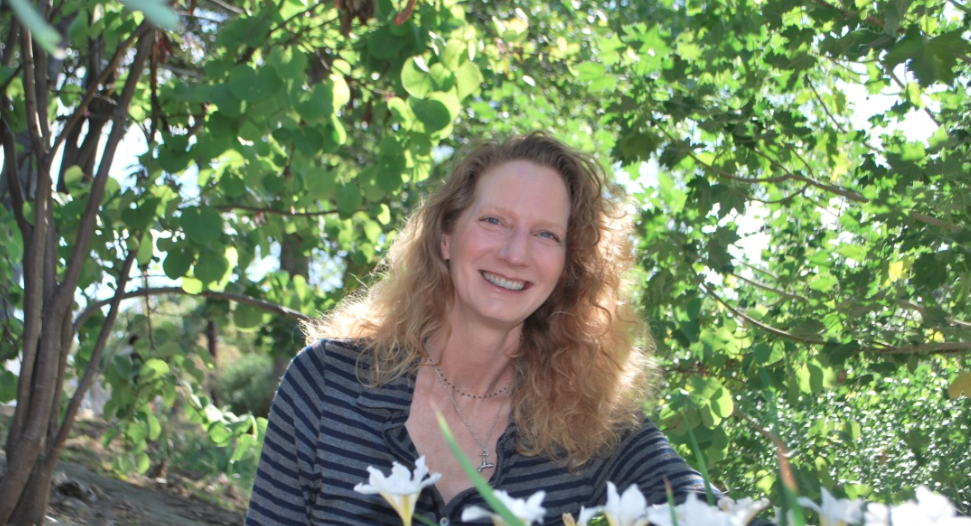
Last week, Melanie Winter, a longtime advocate and champion of the Los Angeles River, died after a battle with lung cancer. We are re-publishing the interview LA Stormwater did with Melanie in 2013 when she had just begun a new project called Water LA. Melanie, thank you for your tireless efforts on behalf of Los Angeles’ natural environment and for being the LA River’s voice and visionary.
For almost 20 years, Melanie Winter has dedicated her life’s work to revitalizing the Los Angeles River and educating Angelenos about the richness and beauty of LA’s founding water body. She established The River Project in 2001 with the mission of working towards a living Los Angeles River, nourished by a healthy watershed. She played an integral role in the development of Los Angeles’ Integrated Resources Plan and the enactment of a low impact development ordinance in 2012. Now Melanie has started a new project called Water LA, which is a residence-based rainwater harvesting program funded with a Proposition 84 grant from the California Coastal Conservancy. LA Stormwater recently sat down with Melanie to learn more about Water LA and to discuss her thoughts on how we can create a more sustainable LA.
LA Stormwater: Tell us how Water LA got started. What was the impetus for this project?
Melanie Winter: Water LA is an outgrowth of our work developing the Tujunga/Pacoima Watershed Plan. The Plan includes dozens of projects – large and small – that are now being implemented across the east San Fernando Valley in partnership with the City, County and State. One of those projects is transforming a ¾-mile concrete median on Woodman Avenue into a landscaped swale that captures rainwater runoff from 126 acres and infiltrates it to the groundwater basin. Since that project includes monitoring stations, we saw it as the perfect opportunity to gather data on the benefits of “urban acupuncture.”
LA’s recent low impact development ordinance, while a positive step, only applies to new developments and major retrofits, which constitute a very, very small fraction of the total land area of the City. That leaves every other parcel of land continuing to create runoff. Green streets are also terrific and should be implemented broadly, especially in areas where they can provide the most benefits, but the City can’t do 5,000 green streets – I doubt they’ll do 100 in my lifetime. The Elmer Avenue project is beautiful and it’s providing useful data, but people see it and think ‘OK, when is the City going to come do that in my neighborhood?’ We wanted to empower everyone in Los Angeles to accomplish projects on their own properties simply, legally, creatively. Think of it as voluntary low impact development (LID).
LA Stormwater: Tell us more about “urban acupuncture.” What does that mean?
Melanie Winter: Urban acupuncture distributes a lot of small projects throughout a region to make a huge impact. Residents are eager to find ways to engage meaningfully and locally in response to big issues like water resources and climate change. Water LA is about giving them tools to create small projects that add up to big results when implemented widely by residents and their neighbors.
Water LA’s motto is ‘Capture, Conserve, Reuse.’ Each project we teach accomplishes at least one of these. With the onset of climate uncertainty and the attendant effects on water resources, the need to aggressively facilitate sustainable local water resources grows daily. We believe that it takes all hands on deck, and residents should be given the tools to contribute.
LA Stormwater: What are Water LA’s main objectives and goals and what do you hope to achieve?
Melanie Winter: This phase of Water LA works on several levels. Our first objective is to make the practice of urban acupuncture accessible, and to get people interested and excited about it. We’re providing hands-on workshops, creating user-friendly homeowner how-to’s and demonstrating that you can do these things while maintaining your own aesthetic, and saving money on your water bill.
We’re generating data to show that smaller is better. We’ve seen research to support this in other parts of the world with similar climates. We can use the data to help LA Sanitation & LA DWP make informed decisions about future homeowner incentives. If one green street costs x and gets y, what if x can get you y cubed when invested in urban acupuncture? We have no doubt that homeowners with incentives can move faster and cover a larger area of land than Street Services can. We need to be moving smart and fast.
We’re also working with Building & Safety to identify and safely revise codes on the books that are unsustainable, and to reduce – and where possible eliminate – permit requirements and fees, or at a minimum to streamline the process so it’s not so daunting. One of our early successes was reducing by 90% both the greywater permit fee and the time it takes to get a system approved.We ultimately want to make it all accessible online.
Different folks have been working on various aspects of this for a while but partly because of that the information out there is fragmented and inconsistent. We’re working to bring everyone together – non-profits and City agencies alike – to support a one-stop online destination for residents to go and get the best guidance. Make it easy to remember, easy to find. “Water LA” is about as simple as it gets. We’re thrilled that LADWP has adopted our ‘Capture, Conserve, Reuse’ motto.
LA Stormwater: As you work with residents who are interested in harvesting rainwater, what surprises you the most about the folks who attend your workshops?
Melanie Winter: One of the gratifying surprises about our Woodman neighborhood is that while we initially approached them with the idea of lowering their water bills, a lot of them had already stopped watering their lawns, or had poured concrete instead of maintaining green space.
Yet given the opportunity to create rainwater capture space, they jumped right on board. Not necessarily because they’ll be saving irrigation water – they mostly don’t irrigate- but because they recognize the opportunity to recharge groundwater, reduce local flooding, clean up stormwater and create some habitat. The fact that our participants get very excited about making these changes is incredibly encouraging. Their willingness to pitch in on one another’s projects has been wonderful. Also, when a neighbor shows up with some homemade lemonade and snacks in the middle of a hands-on workshop, that’s a lovely surprise.
LA Stormwater: You’ve been working on improving LA’s water quality for going on two decades. What changes have you seen since you began working on this issue and what’s been the biggest challenge?
Melanie Winter: The threat of regulatory fines got the City’s attention. There are more conversations across departments, and we’re starting to see more collaboration. But the silos and their inhibiting hierarchies still exist. The IRP got Sanitation to think about multi-beneficial projects, and start connecting water quality to water supply. And it helped demonstrate to DWP that the City was serious about considering stormwater as a resource. Maybe recognition of the challenges posed by climate change will be the thing that forces us to get serious about connecting water resources to land use, and implementing adaptations that can make Los Angeles resilient in the 21st century.
The biggest challenge for us at The River Project may be that for the most part, agencies still talk about water, the river, and the city itself as distinct things. We’re working towards a living Los Angeles River, nourished by a healthy watershed. Water LA is about water quality and water supply, yes, but capturing stormwater reduces peak flows to the river, too. That’s key because that concrete lining our rivers and streams is reaching the end of its serviceable life and will have to be re-built or re-thought. So long as there are systems in place – be they building codes or channelized waterways – that serve to throw away our most precious resource, or planning and zoning codes that prohibit us from creating healthy communities, the system will remain out of balance and a sustainable future for the City will be difficult to realize. We’re looking at the watershed as a functioning whole, and agencies are just not there yet.
LA Stormwater: So, what is LA doing well in the area of improving its water quality? And, adversely, what can we do better?
Melanie Winter: The Integrated Resources Plan (or IRP) was a brilliantly facilitated stakeholder process that laid the foundation for the LID ordinance and the Green Streets program. It not only resulted in some great projects, but also helped move the needle in terms of thinking holistically about water. We’ve seen the beginnings of a discussion about the concept of ‘One Water’ – the notion that our water supply and our rainwater resources are actually related and should be managed as such.
LA has been tightly focused on technical strategies to meet Total Maximum Daily Loads (TMDLs) in order to avoid the financial penalties that result from violations of the Clean Water Act, but with that focus sometimes the broader picture is sacrificed. There’s a tendency to over-engineer things – a preference for machines that require maintenance rather than land-based measures that require stewardship. The latter have more benefits and are more cost effective, but the former is still more comfortable in practice. We have to start trusting in the value of ecosystem services.
I’d like to see another well-facilitated IRP – move the needle a bit further. This time, engaging some key players that weren’t central to the process the first time out – Planning, Building & Safety, Transportation.
LA Stormwater: As far as the water issues facing LA, where would you like to see Los Angeles in another 20 years?
Melanie Winter: By 2035 we could be close to flipping the ratios of imported and local supply through this urban acupuncture approach of capture, conserve, reuse. We will have building codes that support rather than inhibit parcel-based stormwater capture. Parkway swales, rain gardens, greywater systems, etc. will be the norm rather than the exception. I’d like to see fewer thirsty lawns, more native landscapes, more park space and several more miles of living rivers, creeks and streams. Conservation levels could be the highest in the developed world. We could have a network of purple pipes, supplying recycled water to parks and industry. We should have finally taken action on cleaning up our groundwater. These things can easily be achieved if we individually and collectively make a shift to push water to the top of our priorities list. As Carl Sagan said “Anything else you’re interested in is not going to happen if you can’t breathe the air and drink the water. Don’t sit this one out. Do something.”